Charles Haddon Spurgeon (1834-1892) was known as the “Prince of preachers,” and remains influential to this day among Christians of many denominations. The following readings are from a collection of devotions entitled Morning and Evening, Daily Readings, and have been made into a set of public domain audio files by Librivox.
- Opening Acclamation from Psalm 118.
- Hymn: “Nearer My God To Thee”, performed on guitar, by NOH DONGHWAN, Used in accordance with Creative Commons license.
- First Reading: Jeremiah, World English Bible.
- Psalm 69: 7-18, King James Version.
- Gloria Patri, from Wednesday Vespers – Sanctified 2018 Tacoma, uploaded to YouTube by Pacific Lutheran University, and used in accordance with Creative Commons License.
- Second Reading: Romans 6:1-11, World English Bible.
- Organ sequence: Starling Goodwin — Old 100th — Interlude 2, uploaded to Youtube by chordis & organo, used in accordance with Creative Commons license.
- Gospel: Matthew 10:24-39, World English Bible.
- The Lord’s Prayer (sung): From Vespers according to the Brotherhood Prayer Bood, sung at Redeemer Lutheran Church, Fort Wayne, IN, and uploaded to YouTube by Benjamin Mayes, and used in accordance with Creative Commons License.
- Closing prayer: From the Australian Prayer Book.
- Hymn: “Take my Life and Let it Be”, by Vallejo Drive SDA Church, 2017, used in accordance with Creative Commons License.
- Blessing: The Aaronic Blessing from Numbers 6 (King James Version).
- Organ Postlude: Johann Sebastian Bach (1685-1750) “Wer nur den lieben Gott läßt walten” (He who allows dear God to rule), BWV 691, played on 1531 organ at the Mariakerk in Kreward, Netherlands, uploaded by Jon Liinason; Used in accordance with Creative Commons license.
Bible passages were recorded by Librivox, and are in the public domain.
- Prelude: Antonio Cabezon (1510-1556), “Pange Lingua” performed by organist Riyehee Hong at Santa Iglesia Cathedral, Murcia, Used in accordance with Creative Commons license.
- Opening Acclamation from John 6: “I am the bread of life.”
- First Reading: Exodus 19:2-8, World English Bible.
- Psalm: Old 100th. Washington National Cathedral Singers, performed in 2015, used in accordance with Creative Commons license. The organ overpowers the singing at times, so here is the text: “All people that on earth do dwell, sing to the Lord with cheerful voice. Serve him with joy, his praises tell, come now before him and rejoice! Know that the Lord is God indeed; he formed us all without our aid. We are the flock he surely feeds, the sheep who by his hand were made. O enter then his gates with joy, within his courts his praise proclaim! Let thankful songs your tongues employ. O bless and magnify his name! Because the Lord our God is good, his mercy is forever sure. His faithfulness at all times stood and shall from age to age endure.”
- Second Reading: Romans 5: 1-8, World English Bible.
- Motet: William Byrd (1539/40-1623), “O quam suavis est”, performed by Ars Musica, available in Public Domain at Archive.org. Translation: “O how sweet is thy spirit, Lord, thou who, in order to demonstrate thy sweetness to thy children, send down from heaven the sweetest bread unsurpassed, filling the hungry with good things, sending away empty the disdainful rich!”
- Gospel: Matthew 9:35-10:23, World English Bible.
- The Lord’s Prayer: Chanted by unknown congregation, uploaded to YouTube by “LabourerFaith”, and used in accordance with Creative Commons License.
- Blessing: The Aaronic Blessing from Numbers 6 (King James Version).
- Organ Postlude: Matías Aliaga López (1825-1865), “Pange Lingua” performed by organist Riyehee Hong at Santa Iglesia Cathedral, Murcia, Used in accordance with Creative Commons license.
Bible passages were recorded by Librivox, and are in the public domain.
May this brief service of word and music, dedicated to the glory of God, be a blessing to you this day.
- Opening Acclamation and Prelude: “Holy Holy Holy” by Diane Bish, organist, used in accordance with Creative Commons License.
- Lesson 1: Genesis 1:1-2:4, World English Bible.
- Psalm 8. King James Version.
- Gloria Patri: From “Adoremus in aeternum and psalm” uploaded to YouTube by UKOrdinariate, used in accordance with Creative Commons license.
- Lesson 2: 2 Corinthians 13:11-13, World English Bible.
- Hymn: “All Creatures of Our God and King”, Verse 1. Sung by Notre Dame Liturgical Choir, 2017, uploaded to YouTube by ad te levavi, used in accordance with Creative Commons License.
- Gospel: Matthew 28:16-20, World English Bible.
- The Lord’s Prayer: From Matthew 6, King James Version.
- Closing blessing
- Amen: From the Magnificat by Orlando Gibbons, excerpted from a live service sung by the Choir of St. Thomas Fifth Avenue in May 2011. (Fair use).
- Organ postlude: Canzona ‘La Foresta”
This celebration of the word consists of readings corresponding to the Revised Common Lectionary, and music appropriate to the occasion. Pentecost is the “50th day” after the feast of Passover, and was the occasion of the outpouring of the Holy Spirit upon the apostles.
- Prelude: J.S. Bach, “Komm, Gott Schöpfer, Heiliger Geist” (“Come, God Creator, Holy Ghost”), performed by Aldo Locatelli, public domain.
- Opening acclamation, Psalm 51:15.
- Lesson 1: Acts 2:1-21 World English Bible.
- Music: Thomas Tallis: “Loquebantur, Varii Linguis.” Performed by the Tudor Consort, available in Public Domain. Translation: “The Apostles spoke in many languages of the great works of God, as the Holy Spirit gave them the gift of speech, alleluia. They were all filled with the Holy Spirit and began to speak.”
- Psalm 104:24-34, 35b.
- Lesson 2: 1 Corinthians 12:3-13, World English Bible.
- Gospel: John 17:1-11, World English Bible.
- The Lord’s Prayer: From Matthew 6.
- Closing Prayer (sung): “Spirit of the Living God”, sung by the congregation of Faith United Methodist Church in South Burlington, Vermont on Pentecost Sunday 2014, used in accordance with Creative Commons License
- Blessing: The Aaronic Blessing from Numbers 6 (King James Version).
- Organ postlude: “Veni Creator Spiritus” by Rien van Binnendijk at Esztergom, used in accordance with Creative Commons license.
It is a rare person who can step onto a college campus, wade into a crowd of cynics, and hold forth a defense of classic Christianity with wit, compassion and reason. Mr. Zacharias was unexcelled at this particular form of Christian apologetics. As another giant of apologetics, Alister McGrath, wrote in a tribute:
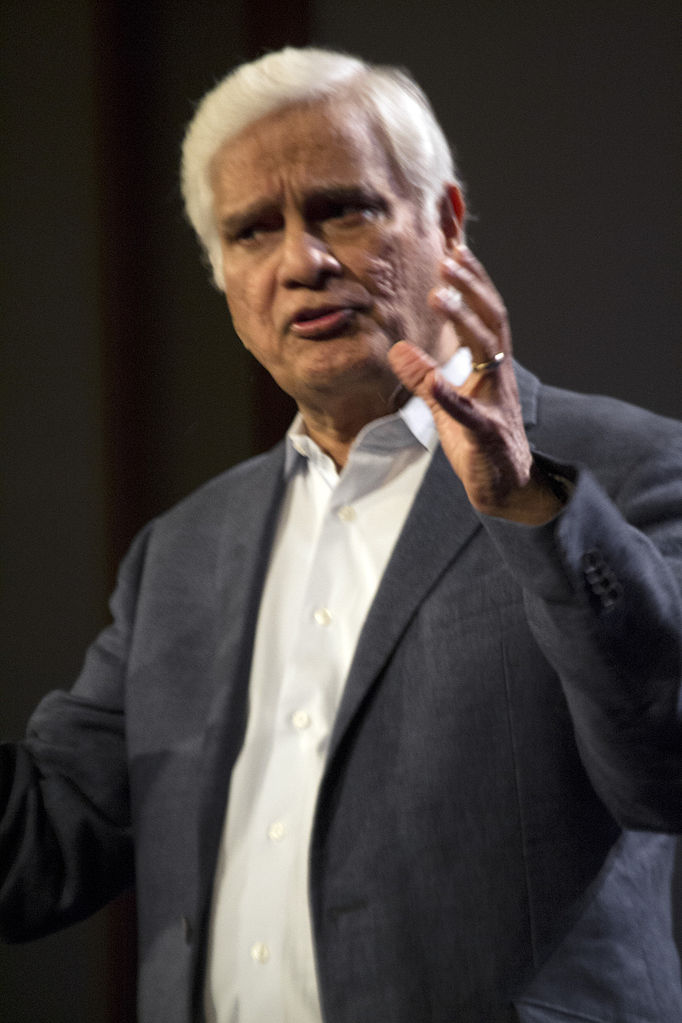
“Ravi Zacharias (1946–2020) will be remembered for his landmark contributions to Christian apologetics, especially his concern to connect the gospel with the life of the mind. … Zacharias’s approach was to demonstrate that Christianity makes rational sense on the one hand, and is able to offer deeply satisfying existential answers to life’s grand questions on the other.”
Born in India to a family of Christian converts, he did not initially embrace the faith and nearly committed suicide as an atheist at age 17. While in the hospital, a bible given to him by a youth pastor turned his life around.
On the RZIM website, his daughter Sarah Davis noted, “He perpetually marveled that God took a seventeen-year-old skeptic, defeated in hopelessness and unbelief, and called him into a life of glorious hope and belief in the truth of Scripture—a message he would carry across the globe for 48 years.”
He left India and later studied in Canada and the U.S, receiving a master of divinity at Trinity Evangelical Divinity School in Illinois, where he was influenced by John W. Montgomery and Norman Geisler.
In turn, he became a prolific writer and speaker, and founded Ravi Zacharias International Ministries, with the mission of “helping the thinker believe and the believer think.” His efforts have influenced many others, ranging from current Evangelical leaders, to a devout roommate of mine in medical school, to football star and motivational speaker Tim Tebow.
Notable milestones of his career include rising to prominence at a conference for evangelists hosted by Billy Graham in 1983, speaking at the Veritas Forum at Harvard University in 1992, and speaking to the academic community of Virginia Tech after the tragic shooting incident in 2007. He controversially accepted an offer in 2004 to engage in a major dialogue with the Latter Day Saints in Salt Lake City.
He died of cancer at age 74.
Further reading:
New York Times: https://www.google.com/amp/s/www.nytimes.com/2020/05/27/us/ravi-zacharias-dead.amp.html
For those of you who come from traditions that permit the celebration of communion without a priest, we offer this virtual celebration of the Eucharist, or Holy Communion. All baptized Christians are welcome to share with us in this holy mystery. A companion video will be coming shortly. We recommend coming to the table after a time of preparation, such as by listening to one of our “celebration of the word” files, or otherwise engaging in Bible reading, prayer, and confession.
- Hymn: “Jesus Paid it All” featuring Greg Kunde, Dean Peterson vocalists and Diane Bish, organ, from a uprogram entitled “The Name of Jesus”, used in accordance with Creative Commons license.
- Welcome (Presbyterian): “This is the Lord’s table. Our Savior invites those who trust him to share the feast which he has prepared.”
- Sursum Corda: excerpted from a church service at St. Barnabas Anglican Church, Ottawa Canada, 2012, in Community Audio section of Internet Archives.
- Sanctus: Mass for 4 voices, by William Byrd, performed by Ensemble Morales, used in accordance with Creative Commons License. Text: “Holy holy holy Lord God of Hosts. Heaven and earth are full of your glory. Hosanna in the highest. Blessed is He who comes in the name of the Lord. Hosanna in the highest.”
- Words of institution: From 1 Corinthians 11
- Eucharistic prayer: from Holy Communion Bromley Parish Church 18th March 2020, uploaded to YouTube by James Harratt, used in accordance with Creative Commons license.
- The Lord’s Prayer, from Matthew, King.
- Agnus Dei: Mass for 4 voices, by William Byrd, performed by Ensemble Morales, used in accordance with Creative Commons License. Text: “Lamb of God, who takes away the sin of the world, have mercy on us. Lamb of God, who takes away the sin of the world, have mercy on us. Lamb of God, who takes away the sin of the world, grant us your peace.”
- Anthem: Ave verum corpus, by William Byrd. Performed by Ars Mvsica; public domain at Archive.org. English Translation: “Hail, true Body, born of the Virgin Mary, having truly suffered, sacrificed on the cross for mankind, from whose pierced side water and blood flowed: Be for us a foretaste [of the Heavenly banquet] in the trial of death! O sweet Jesus, O holy Jesus, O Jesus, son of Mary, have mercy on me. Amen”
- Post-communion prayer: From a Lenten service Feb 14, 2016 at Saint James Church, Warrenton, VA, on YouTube, used according to Creative Commons License
- Musical Postlude: Bach, “I am Standing with One Foot in the Grave” BWV 156; Anonymous performance, public domain.
In celebration of Ascension, I have curated an audio experience of virtual worship, using the surprisingly rich body of materials available in the Public Domain and Creative Commons. Readings correspond to the Revised Common Lectionary.
- Prelude: Girolamo Frescobaldi, Canzon quarta, F 8.05c (for Trumpet and Organ), Performed by Michel Rondeau – Aline Letendre, available at MusOpen, used in accordance with Creative Commons license.
- Opening acclamation: Psalm 47:5.
- Hymn: “Hail the Day That Sees Him Rise”, Public Domain.
- Lesson 1: Acts 1:6-14, World English Bible.
- Psalm Psalm 68:1-10 and 32-35, King James Version.
- Hymn: “Let All Mortal Flesh Keep Silence.” Uploaded to YouTube by
Christina Igupen, used in accordance with Creative Commons license. - Lesson 2: 1 Peter 4:12-14; 5:6-11, World English Bible.
- Gospel: John 17:1-11, World English Bible.
- The Lord’s Prayer: Chanted by unknown congregation, uploaded to YouTube by “LabourerFaith”, and used in accordance with Creative Commons License.
- Concluding prayer: Stanza 4 of the hymn “As Of Gladness Men of Old”, written by William C. Dix (1837-1898).
- Blessing: The Aaronic Blessing from Numbers 6 (King James Version).
- Organ postlude: Guillaume Du Fay: Hymn In Ascensione Domini, performed by David Joseph Stith on the organ at First Presbyterian Church in Austin, Texas, used in accordance with Creative Commons license.
This little audio file is offered for your edification, and to the glory of God.
- Opening acclamation: Psalm 51:15
- Hymn: “Amazing Grace” for flute, Angela Brown, and organ, Diane Bish, from program entitled “Hymns and Sacred Songs”, used in accordance with Creative Commons license.
- Lesson 1: Acts 17:22-31, World English Bible.
- Psalm 66:8-20, NET Bible, uploaded to YouTube by “dailyvideobible”, used in accordance with Creative Commons license.
- Music: J. S. Bach: Cantata No. 207a: “O Praise the Lord Most Holy”, from a program by Diane Bish entitled “The Many Moods of Bach”, used in accordance with Creative Commons License.
- Lesson 2: 1 Peter 3:13-22 , World English Bible.
- Gospel: John 14:15-21, World English Bible.
- The Lord’s Prayer
- Organ postlude: J.S. Bach, “In Herr Jesu Christ dich zu uns wend, BWV 632”, performed by Aldo Locatelli, in the public domain.
These readings correspond to the Revised Common Lectionary. I offer this effort to God’s glory and for your enjoyment.
- Opening acclamation.
- Hymn: “Crown him with many crowns” by unknown singers. Public Domain. From Internet Archive.
- First Reading: Acts 7:55-60 (World English Bible).
- Psalm 31:1-5, 15-16 (King James Version).
- Gloria Patri: Excerpted from an audio cassette of a choir festival in Evanston, IL, circa 1993.
- Second Reading: 1 Peter 2:2-10 (World English Bible).
- Gospel: John 14: 1-14.
- The Lord’s Prayer: Chanted by unknown congregation, uploaded to YouTube by “LabourerFaith”, and used in accordance with Creative Commons License.
- Blessing: The Aaronic Blessing from Numbers 6 (King James Version).
- Musical postlude: Charles-Marie Widor, Organ Symphony no. 5, Op. 42 no. 1, performer Paul Pittman, in the public domain. At MusOpen.
I have put this audio file together from public domain sources, mainly LibriVox (for bible readings), MusOpen (for royalty Free Music) and the Community Audio section of the Internet Archives.